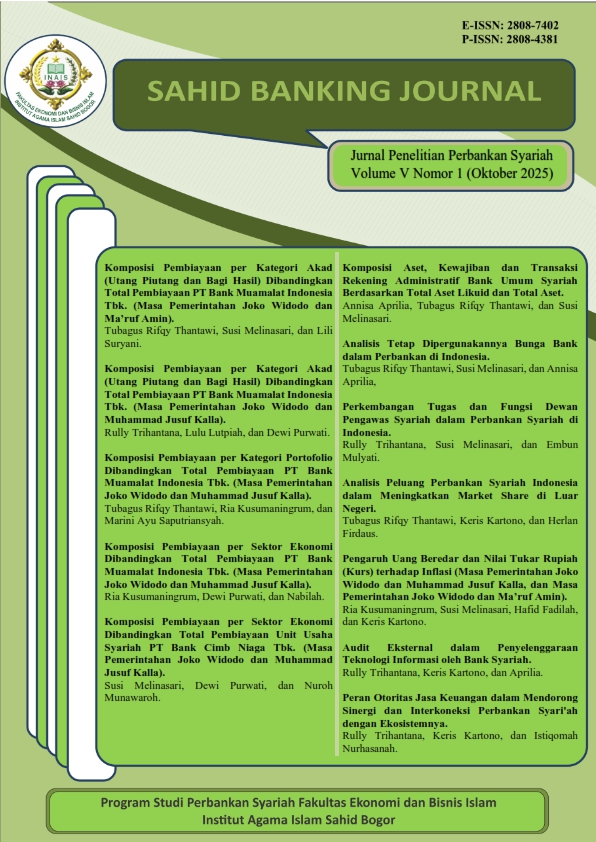
ANALYSIS OF THE CONTINUED USE OF BANK INTEREST IN THE INDONESIAN BANKING SECTOR
DOI:
https://doi.org/10.56406/sahidbankingjournal.v5i1.270Keywords:
Banking, Bank Interest, Monetary Policy, InvestmenAbstract
The financial services sector is a sector that is linked to almost all sectors in the national economy. A bank is an agency that collects funds from the public in the form of savings and distributes them to the public in the form of credit. In funding activities, of course the bank determines the amount of interest that is regulated for the bank and customers. Interest is a form of compensation given by capital borrowers to capital owners for the loss of use of capital due to lending and borrowing activities during a certain time. This research aims to analyze the continued use of bank interest in banking in Indonesia. This reaserch uses data observation methods from the Badan Pusat Statistik (BPS) regarding bank interest rate data, as well as investment realization data in the west Java province for 2006-2022. The data instrument used comes fromt BPS reports regarding interest rates. The results of the research show that interest rates are a form of remuneration. Interest rates play an important role in banking because they attract customers and also serve as a form of obtaining banking profits. Apart from that, from this research it is proven that there is a negative relationship between interest rates and investment realization in West Java province. Interest rates are the policy of the Bank Indonesia monetary authority, which is regulated in Bank Indonesia regulations and other regulations.
References
Bank Indonesia. (2005). Peraturan Bank Indonesia No. 7/28/PBI/2005 Tentang Perubahan Kedua atas Peraturan Bank Indonesia No. 6/11/2004 Tentang Suku Bunga Penjaminan Simpanan Pihak Ketiga dan Pasar Uang Antar Bank. Bank Indonesia.
Bank Indonesia. (2020). Tujuan Kebijakan Moneter. Retrieved from Bank Sentral Republik Indonesia: https://www.bi.go.id/id/fungsi-utama/moneter/default.aspx
Departemen Kebijakan Ekonomi dan Moneter. (2022, Desember 23). Tinjauan Kebijakan Moneter Desember 2022. Retrieved from Bank Indonesia: https://www.bi.go.id
Gumiwang, A. G. (2009). Hubungan Antara Money Supply, Tingkat Suku Bunga & Output Aggregate. FE Universitas Indonesia, 26.
Indonesia. (1999). Undang-undang No.10 Tahun 1998 Tentang Perubahan Undang-undang No.7 Tahun 1992 Tentang Perbankan. Jakarta: Sinar Grafika.
Otoritas Jasa Keuangan. (2019). Buku 2-Perbankan Seri Literasi Keuangan Perguruan Tinggi. Jakarta.
Otoritas Jasa Keuangan. (n.d.). Mengenal Jenis-Jenis Suku Bunga Bank. Retrieved from Otoritas Jasa Keuangan: https://sikapiuangmu.ojk.go.id
Prasetiantono, T. A. (2000). "Keluar Dari Krisis: Analisis Ekonomi Indonesia". Gramedia Pustaka Utama.
Sembiring, S. (2012). Hukum Perbankan Edisi Revisi. Bandung: Mandar Maju.
Umar Bakti, M. S. (2018). Pengaruh Inflasi dan Suku Bunga Terhadap Investasi di Provinsi Lampung Periode 1980-2015. Ekonomi, 278.
Downloads
Published
How to Cite
Issue
Section
License
Copyright (c) 2025 Tubagus Rifqy Thantawi, Susi Melinasari, Annisa Annisa

This work is licensed under a Creative Commons Attribution 4.0 International License.