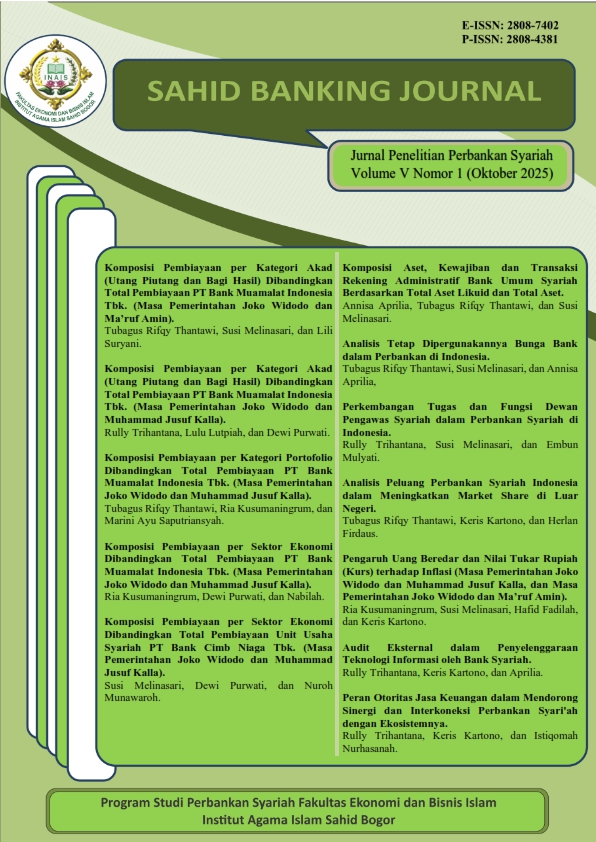
COMPOSITION OF FINANCING BY ECONOMIC SECTOR RELATIVE TO TOTAL FINANCING AT PT BANK CIMB NIAGA TBK. (DURING THE ADMINISTRATION OF JOKO WIDODO AND MUHAMMAD JUSUF KALLA).
DOI:
https://doi.org/10.56406/sahidbankingjournal.v5i1.268Keywords:
Financing, PT Bank CIMB Niaga Tbk, Economic SectorAbstract
This study aims to analyze the composition of financing per economic sector distributed by PT Bank CIMB Niaga Tbk (Sharia Business Unit) during the years 2017, 2018, and 2019. The subjects of this research are the financing data allocated to five main sectors: industry, trade, consumption, housing, and services. The method used in this study is quantitative descriptive analysis to illustrate the proportion and contribution of each sector to the bank's total financing. The results of this study indicate that there are five types of economic sectors that consistently contribute over 10% to the total financing of PT Bank CIMB Niaga Tbk, with the industrial, trade, and housing sectors being the most dominant. This research concludes that PT Bank CIMB Niaga Tbk demonstrates a strong commitment to supporting strategic sectors that have the potential to enhance economic growth and community welf are. The findings emphasize the importance of appropriate financing allocation strategies to support the development of crucial economic sectors.
References
Arifin, Z. (2018). Perbankan Syariah: Teori dan Praktik. Jakarta: Rajawali Pers.
Badan Pusat Statistik (BPS). (2021). Statistik Perekonomian Indonesia. Jakarta: BPS.
Bank Indonesia. (2020). Laporan Ekonomi Syariah 2020. Jakarta: Bank Indonesia.
Halim, A. (2019). Analisis Sektor Perdagangan dalam Perekonomian Indonesia. Jurnal Ekonomi dan Bisnis, 12(2), 91-100.
Harian, R. (2021). Strategi Pembiayaan Bank Syariah dalam Mendukung UKM. Media Bisnis, 5(1), 23-30.
Kementerian Koperasi dan UKM. (2021). Laporan Tahunan Koperasi dan UKM 2021. Jakarta: Kemenkop UKM.
Masyita, D. (2018). Peran Bank Syariah dalam Pembangunan Ekonomi Indonesia. Jurnal Ekonomi dan Bisnis, 21(2), 123-135.
Otoritas Jasa Keuangan. (2019). Statistik Perbankan Syariah 2019. Jakarta: OJK.
Prabowo, S. (2021). Perkembangan Sektor Jasa di Indonesia: Peluang dan Tantangan. Jurnal Manajemen, 8(3), 45-54.
PT Bank CIMB Niaga Tbk. (2017). Laporan Tahunan 2017. Jakarta: CIMB Niaga.
PT Bank CIMB Niaga Tbk. (2018). Laporan Tahunan 2018. Jakarta: CIMB Niaga.
PT Bank CIMB Niaga Tbk. (2019). Laporan Tahunan 2019. Jakarta: CIMB Niaga.
Sari, R., & Rahman, A. (2019). Inovasi Produk Pembiayaan pada Bank Syariah di Indonesia. Jurnal Manajemen dan Kewirausahaan, 7(1), 45-58.
Smith, J. (2020). The Role of SMEs in Economic Development. International Journal of Business and Management, 15(4), 67-78.
Statista. (2020). E-commerce in Indonesia Statistics & Facts. Diakses dari Statista.
Sukmawati, D. (2020). Dukungan Bank Syariah terhadap Sektor Perindustrian di Indonesia. Jurnal Keuangan dan Perbankan, 9(1), 15-29.
Undang-Undang Republik Indonesia Nomor 10 Tahun 1998 tentang Perubahan Atas Undang-Undang Nomor 7 Tahun 1992 tentang Perbankan.
Undang-Undang Republik Indonesia Nomor 21 Tahun 2008 tentang Perbankan Syariah.
Yusuf, M. (2022). Dampak Ekonomi Makro terhadap Pola Konsumsi Masyarakat. Jurnal Ekonomi Pembangunan, 10(2), 34-45.
Downloads
Published
How to Cite
Issue
Section
License
Copyright (c) 2025 Susi Melinasari, Dewi Puspita Sari, Nuroh Munawaroh

This work is licensed under a Creative Commons Attribution 4.0 International License.