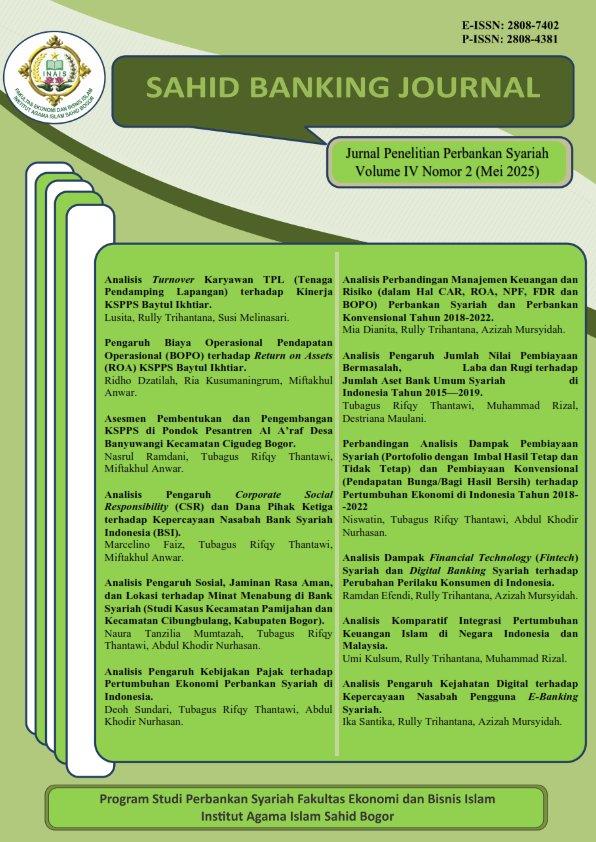
ANALYSIS OF THE IMPACT OF TAX POLICY ON THE ECONOMIC GROWTH OF ISLAMIC BANKING IN INDONESIA
DOI:
https://doi.org/10.56406/sahidbankingjournal.v4i2.256Keywords:
Income Tax (PPh), Value Added Tax (PPN), Land and Building Tax (PBB), Capital Adequacy Ratio (CAR), Third Party Funds (DPK) and Sharia Banking Economic GrowthAbstract
This study aims to find out whether or not there is an influence of tax policies on the growth of the sharia banking economy in Indonesia. The subjects of this study are Income Tax (PPh), Value Added Tax (PPN), Land and Building Tax (PBB), Capital Adequacy Ratio (CAR) and Third Party Funds (DPK) in Sharia Commercial Banks in Indonesia. The result of this study is that there is partially no significant influence between the variables of Income Tax (PPh), Value Added Tax (PPN), Land and Building Tax (PBB) on the Capital Adequacy Ratio (CAR) and Third Party Funds (DPK) in Sharia Commercial Banks in Indonesia. However, simultaneously there is a significant influence between the variables of Income Tax (PPh), Value Added Tax (PPN), Land and Building Tax (PBB) on the Capital Adequacy Ratio (CAR) and Third Party Funds (DPK) in Sharia Commercial Banks in Indonesia.
References
A, H., Bawono, I., & A., D. (2020). Perpajakan: Konsep, Aplikasi, Contoh dan Kasus. Yogyakarta: Salemba Empat.
Acemoglu, D., & Robinson, J. A. (2012). Why Nations Fail: The Origins of Power, Prosperty, and Poverty. Crown Publishers.
Acemoglu, D., Johnson, S., & Robinson, J. A. (2005). Institutions as a Fundamental Cause of Long-run Economic Growth. Handbook of Economic Growth, IA, 385-472.
Aghion, P., & Howitt, P. (1992). A Model of Growth through Creative Destruction. Econometrica, 60(2), 323-351.
Aghion, P., & Howitt, P. (1992). A Model of Growth through Creative Destruction. Econometrica, 60(2), 323-351.
Antonio, M. S. (2010). Bank Syariah: Dari Teori ke Praktik. Jakarta: Gema Insani.
Ariff, M., & Iqbal, M. (2011). The Foundation of Islamic Banking: Theory, Practice and Education. Edward Elgar Publishing.
Ascarya. (2012). Akad dan Produk Bank Syariah. PT. Raja Grafindo Persada.
Back, T., Kunt, A. D., & Merrouche, Q. (013). Islamic vs. Conventional Banking: Business as Usual? Journal of Financial Stability, 9(3), 434-447.
Chapra, M. U. (2007). The Isamic Vision of Development in the Light of Maqasid Al-Shari'ah. Islamic Research and Training Institute, Islamic Development Bank.
Chapra, M. U., & Khan, T. (2008). Regulation of Islamic Financial Institutions: The Need for a New Paradigm.
Dewi, G. A., & Lestari, P. V. (2020). Pengaruh Tingkat Suku Bunga, Inflasi,dan Produk Domestik Bruto Terhadap Dana Pihak Ketiga Bank Umum Syariah di Indonesia. Jurnal Ekonomi Syariah Teoru dan Terapa, 7(1), 1-15.
Dusuki, A. W., & Abdullah, N. I. (2007). Why Do Islamic Banks Differ from Conventional Banks? Journal of Islamic Economics, Banking and Finance, 3(4), 12-27.
Easterly, W., & Rebelo, S. (1993). Fiscal Policy and Economic Growth: An Empirical Investigation. Journal of Monetery Economics, 32(3), 417-458.
Hasssan, M. K., & Lewis, M. K. (2007). Handbook of Islamic Banking. Edward Elgar Publishing.
Hudaefi, F. A., & Ghofar, A. (2018). Determinants of Islamic Bank Deposits in Indonesia : Macroeconomics and Bank-Specific Factors. Al-Iqtishad: Jurnal Ilmu Ekonomi Syariah, 10(1), 109-126.
Islamic Financial Services Board. (2023). IFSB Stability Report 2023. Kuala Lumpur: Islamic Financial Services Board.
Jobanputra, R., & Narayan, K. P. (2017). The Determinants of Human Capital in Islamic Banking. Economic Modelling, 60, 335-344.
Karim, A. A. (2010). Bank Islam: Analisis Fiqih dan Keuangan. Jakarta: PT. RajaGrafindo Persada.
Karim, A. A. (2014). Bank Islam: Analisis Fiqih dan Keuangan . Jakarta: PT RajaGrafindo Persada.
Karim, A. A. (2019). Ekonomi Mikro Islami. PT RajaGrafindo Persada.
Khan, T., & Tarazi, M. (2021). Islamic Fintech: Opportunnities and Challenges. Journal of Islamic Accounting and Business Research, 12(8), 1195-1211.
Lucas, R. E. (1988). On the Mechanics of Economic Development. Journal of Monetary Economics, 22(1), 3-42.
Mangkoesoebroto, G. (1995). Ekonomi Pulik Edisi Ketiga. Yogyakarta: BPFE.
North, D. C. (1990). Institutions, Institutional Change and EConomic Performance. Cambridge: Cambridge University Press.
Otoritas Jasa Keuangan. (2023). Peraturan Otoritas Jasa Keuangan Nomor 32 Tahun 2023 tentang Permodalan Bank Umum Syariah. Otoritas Jasa Keuangan (OJK). Jakarta: Otoritas Jasa Keuangan.
Pandiangan, L. (2008). Modernisasi Dan Reformasi Pelayanan Perpajakan. Jakarta: Elex Media Komputindo.
Romer, P. M. (1990). Endogenous Technological Change. Journal of Political Economy, 98(5), 71-102.
Downloads
Published
How to Cite
Issue
Section
License
Copyright (c) 2025 Deoh Sundari, Tubagus Rifqy Thantawi, Abdul Khodir Nurhasan

This work is licensed under a Creative Commons Attribution 4.0 International License.